Eddie Friel
The Power of the DogEddie Friel, called Eddie the Butcher, is Matt Sheehan’s debt collector and one of the neighborhood’s most feared enforcers. His attempt to collect from Sean Callan’s circle ends with Callan killing him, an act that gives Eddie a lasting place in Callan’s reputation and in the reasoning used to draw Callan back into criminal work.
Identity and Role
Eddie’s nickname captures the menace on which his work depends. He collects money for Matt Sheehan, whose standing in the neighborhood is supported in part by Eddie’s reputation. When Eddie comes to collect, people are expected to pay; refusal brings violence, but does not cancel the debt. His function is therefore more than collecting money: he makes Sheehan’s authority tangible and helps maintain a system in which fear reinforces financial obligation.
The account of Kenny Maher’s killing establishes the reach of that reputation. The police are the only people in the neighborhood who do not know who killed Kenny; the news has reached everyone else, including Eddie. His arrival is consequently treated as bad news for Michael Murphy. The contrast between the neighborhood’s knowledge and the police’s ignorance places Eddie within a local order governed by information, intimidation, and personal power rather than formal law.
Confrontation with Sean Callan
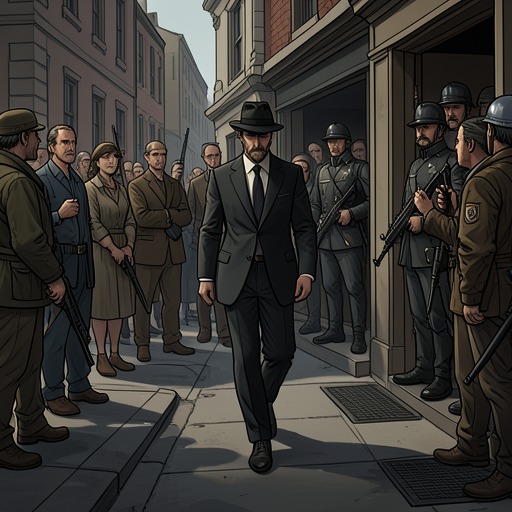
Eddie enters about ten minutes after the preceding events. He draws a .38 and orders the people present to get down on their knees. Sean Callan answers by drawing a .22 and killing him. The exchange turns Eddie’s familiar role as the person who compels others into submission against him: he arrives expecting his reputation and weapon to control the encounter, but Callan refuses to yield.
The scene marks a consequential change in Callan’s standing. Eddie’s reputation has depended on the assumption that threats will secure compliance; Callan’s response breaks that assumption at a high cost. Eddie is not merely an obstacle in an isolated confrontation. His death becomes an act others can point to when describing what Callan is capable of, and it helps establish the pattern of retaliation that follows him.
Aftermath and Narrative Significance
Later, Sal Scachi invokes Eddie Friel when telling Callan that his taste for revenge has made him too dangerous to remain outside their organization. Eddie’s death is recalled as evidence of Callan’s character and as leverage in an argument that Callan has no real choice but to join them. The reference gives the earlier confrontation a second consequence: the killing that asserted Callan’s independence is recast as a reason others claim they must control him.
Eddie’s brief appearance thus connects neighborhood extortion to the wider criminal world surrounding Callan. As Sheehan’s collector, he embodies the immediate coercion of the street; as a name used later to explain Callan’s reputation, he remains present after his death. His narrative importance rests on that reversal: the enforcer who arrives to impose another person’s power becomes the episode through which Callan’s own capacity for violence is remembered and exploited.